This week in AI 👇 Claude got better, Context got harder.
lack Code, Fable 5.1, Apple M6, OpenAI’s new chip — and why bigger context windows are starting to look like the wrong benchmark.
Hey friend,
I’m in SF this week, and a lot of the conversations I’ve had here have been about what happens once the models are actually good enough.
Because as they get better, the harder technical problems around them start surfacing: context, memory, retrieval, caching, orchestration, and figuring out what information should reach the agent in the first place. That’s the thread running through this week’s issue.
Summary
Read time: 8 min
Highlights Of The Week
Webinar: Intro to tokenomics: What Every Manager Needs to Understand About AI Spend
Also This Week:
Context As A Service · The Context Window Myth
Signals
1. Fable 5.1 improves long-horizon coding and agentic work, with much cheaper cache reads.
2. Slack launched Slack Code, dedicated channels where your team and its agents ship together, with Claude, ChatGPT, Devin, and Copilot as launch partners
3. Z.ai shipped GLM-5.3, a 743B-parameter, 1M-context, MIT-licensed open-weight model, with gains that came from post-training alone
4. Apple announced the M6, its first 2nm chip, and the M5 Ultra, built into a new Mac mini and Mac Studio aimed at running models on device
5. OpenAI says its Jalapeño chip, built with Broadcom, beats Nvidia in testing while running at or below 550W in real workloads
6. Gemini's new video model cuts costs 66% by watching only what matters
7. Google introduced Gemini 3.5 Transcribe, its most precise speech-to-text model yet
8. Google Cloud shows how to scale OKF bundles across an organization with Knowledge Catalog
Context is becoming infrastructure
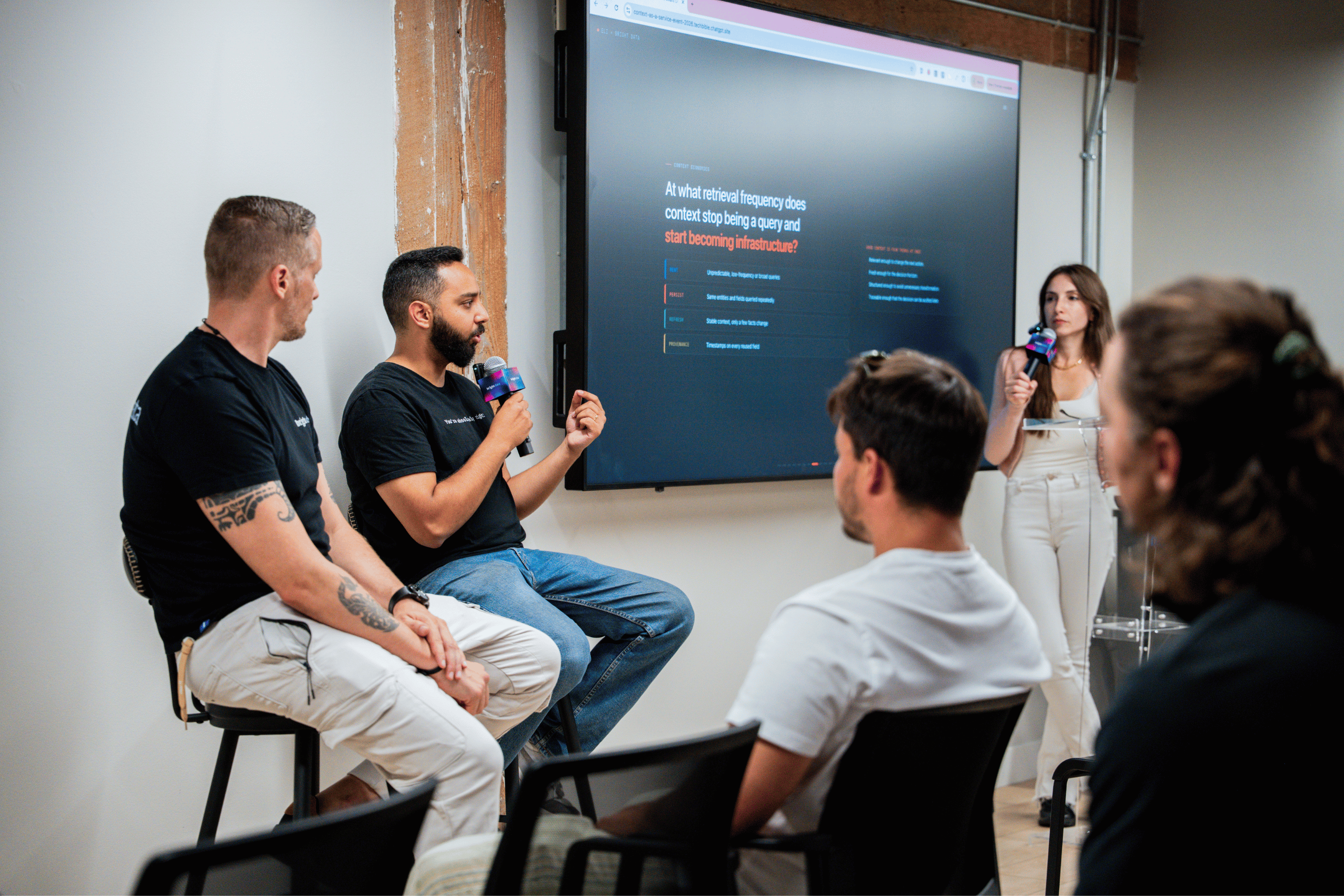
I hosted another AI infra dinner with founders in SF, this time around Context as a Service. Everyone talks about 100K, 500K and 1M-token context windows, but long-running agents don’t just need more context. They need the right information, in the right form, at the right time.
George Fahmy shared a great example: pruning old context cut token usage by ~30%, but made the workload 3x more expensive because it broke prompt caching. Rafael Levi showed the data side of the same problem: a 17K-token webpage can become ~107 tokens when you only send the fields the agent actually needs.
And the research backs it up:
Oolong — GPT-5, Claude Sonnet 4 and Gemini 2.5 Pro all scored below 50% on harder 128K reasoning tasks.
ATLAS — tested 26 models up to 1M tokens and found an average 24.3% performance decay as context scaled.
Long-Context WebAgents — success fell from ~40–50% to below 10% as agent histories grew, with agents looping and losing the original goal.
Sliding-window beats linear attention — a new paper found a simpler sliding-window approach performed 2–10x better than post-trained linear attention on two long-context benchmarks, while using far less memory.
Google: teaching LLMs to know what they don’t know — another useful direction: models need better ways to represent uncertainty instead of confidently acting when they don’t have enough information.
The shift is from “how much can I fit in the window?” to: what should I retrieve, cache, summarise, persist, refresh — or never send to the model at all?
That’s why I think CaaS becomes a much bigger part of the agent stack, and why the metric worth watching isn’t cost per token. It’s cost per verified successful task — something we’re already starting to roll out inside ELI.
15 Best Free Claude Code GitHub Repos That Make It 100x More Useful - Worth wiring in if you're running on Codex or Claude Code day to day.
What’s In Their Stack?
This week: Anna Chernikova
Founder and CEO of Sprites, Anna has 32 tools across 27 categories in her stack.
Her AI layer runs on Anthropic and OpenAI, with Fireflies.ai handling meeting notes and Fireworks powering orchestration and MLOps.
Then there's the rest of the stack: See Anna's full stack →
Want visibility on what's in yours? Map it with ELI.work
Stay curious.
Ghita